ONE SOURCE BENEFITS | MILITARY & VETERAN BENEFITS
“Wraparound coverage” is one of those phrases that shows up in every TRICARE For Life explanation without anyone actually explaining what it means. It sounds simple enough, TRICARE wraps around Medicare, but most retirees have never seen what that actually looks like on a real bill. So let’s open one up and walk through it.
What “Wraparound” Actually Means
TRICARE For Life doesn’t process your claim first, and it doesn’t process it separately. Medicare adjudicates the claim first, decides what it covers, and pays its share. Whatever’s left over, the deductible, the copay, the coinsurance, gets sent to TRICARE For Life automatically in most cases, and TRICARE pays that remaining balance. That’s the wraparound: one claim, two payers, almost no work on your end.
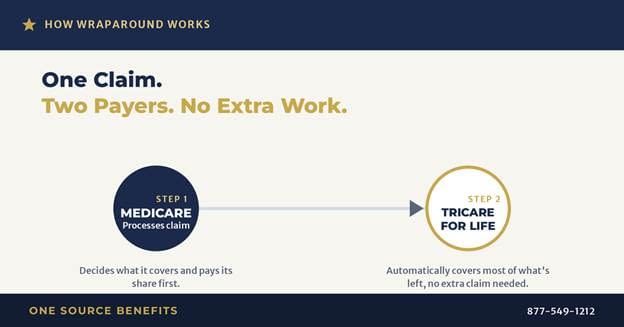
This automatic handoff is what makes TRICARE For Life different from a typical Medicare Supplement plan. There’s no separate card to show, no separate claim to file for most services, and no waiting to get reimbursed. The system is built to pass the balance along on its own.
A Real Claim, Walked Through
Say a retiree in Dayton goes in for an outpatient physical therapy session that costs $150 under Medicare’s approved amount. Medicare pays 80 percent of that, $120, leaving a $30 balance. Under a lot of other coverage, that $30 becomes the patient’s problem. Under TRICARE For Life, that $30 gets picked up automatically once Medicare processes its portion. The retiree typically never sees a bill for it.
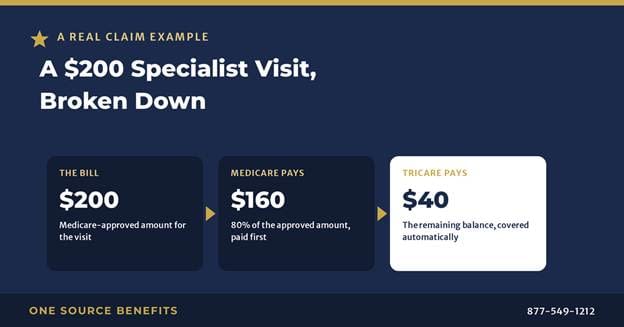
That’s the pattern across most outpatient care, hospital stays, and approved services: Medicare’s share first, TRICARE’s share second, and very little left for the retiree to pay out of pocket.
Where the Wraparound Doesn’t Reach
Wraparound coverage only works on claims Medicare processes in the first place. If a service isn’t covered by Medicare at all, routine dental, vision, or hearing aids being the most common examples, there’s nothing for TRICARE For Life to wrap around, since there’s no Medicare payment to follow. That’s why those categories tend to be the gap retirees run into most often.
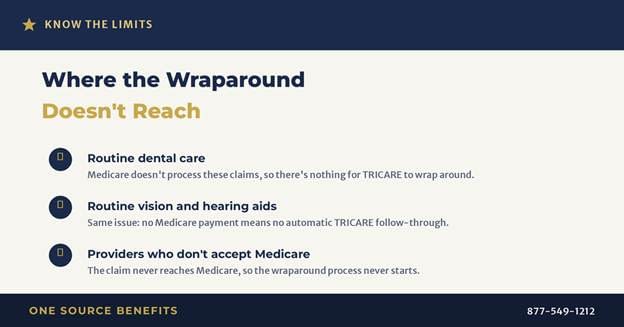
It’s also worth knowing that seeing a provider who doesn’t accept Medicare can interrupt the wraparound process entirely, since the claim never gets to Medicare in the first place. Sticking with Medicare-participating providers keeps the automatic handoff working the way it’s designed to.
What This Means for Retirees in Ohio
Ohio is home to a large population of military retirees, anchored by the presence of Wright-Patterson Air Force Base near Dayton. Whether you’re in Dayton, Columbus, Cincinnati, Cleveland, Akron, Toledo, or a smaller community across the state, the same TRICARE For Life and Medicare rules apply, and having someone local who understands both makes the process easier. If you want a free, unbiased second opinion, Ohio’s SHIP counseling program, OSHIIP (the Ohio Senior Health Insurance Information Program), is available at 1-800-686-1578.
For VA care, the Dayton VA Medical Center is the anchor facility for a lot of Ohio retirees, with a VA clinic right on Wright-Patterson itself and community clinics in Lima, Middletown, and Springfield. On the TRICARE side, Ohio falls under the TRICARE East Region, administered by Humana Military, while TRICARE For Life claims themselves are handled separately by Wisconsin Physicians Service (WPS) at 1-866-773-0404.
Worth knowing too: Ohio fully exempts military retirement pay from state income tax, no age or income restrictions, so your pension isn’t taxed twice. For hospital networks, Ohio State Wexner Medical Center, Cleveland Clinic, Kettering Health, and UC Health/Cincinnati are the major systems most Medicare Advantage and Medicare Supplement plans build their networks around. If you have questions about state-level veteran benefits beyond TRICARE and Medicare, the Ohio Department of Veterans Services can be reached at 614-644-0898.
A Question a Lot of Ohio Retirees Ask
Plenty of Ohio retirees, whether they call Dayton, Columbus, Cincinnati, or Cleveland home, spend part of the winter somewhere warmer. The good news is that wraparound coverage doesn’t stop at the state line. Medicare and TRICARE For Life both work nationwide, so as long as you’re seeing a provider who accepts Medicare, the same automatic handoff applies whether you’re in Ohio or Florida for the season.
Quick Recap
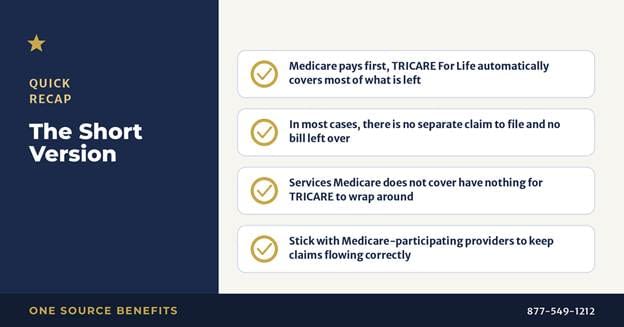
- The core mechanic: Medicare pays first, TRICARE For Life automatically covers most of what’s left.
- Why it feels seamless: In most cases, there’s no separate claim to file and no bill left over.
- The gap to know about: Services Medicare doesn’t cover, like routine dental, vision, and hearing, have nothing for TRICARE to wrap around.
- The one rule that keeps it working: Stick with providers who accept Medicare so claims flow through the system correctly.
Questions About How This Applies to Your Coverage?
Understanding the mechanics is one thing. Knowing how it plays out with your specific providers, your specific claims, and your specific situation is another. I’ve spent 36 years helping retirees make sense of exactly this kind of coordination, and I take particular care with military retirees since I have family who served myself.
If you want to walk through how wraparound coverage applies to your situation in Ohio, give me a call at 877-549-1212. You’ll get real answers, not a runaround.